
My
appeal comes with 36 questions.
13
books have been provided.
One
book for each Member of the Judicial Service
Commission.
Each Member has their own book in which to
provide their answers.
Each Member can write down his/her name on each
book.
On
completion I will make arrangements to collect
the books from your offices.
Thank you.
….................................................................................................................
Name of Member who completed this
book.
One
book will be sent to the South African Human
Rights Commission
and
an opportunity will be afforded there to also
complete the same questionnaire
 .
I am not appealing
to the Judicial Service Commission so that
Erasmus can get into trouble. I am appealing to
the Judicial Service Commission to show that
there is a strong case that Erasmus has done
wrong and the easiest way to put a spoke in the
wheel to prevent this from going to a criminal
court is for the National Director of Public
Prosecutions to be persuaded or made to admit
that there is error here and in order to avoid a
situation where people do end up going to jail
then it is now up to the National Director of
Public Prosecutions to simply give back to me
what has, essentially, been stolen from me by
none other than the National Director of Public
Prosecutions.
It is my opinion,
which, I think is indeed supported by a lot of
facts, that, Erasmus, in his judgement against
me, has made a lot of mistakes and he has ruined
my life but I have never spoken to this man and
to be honest, I mean no harm to Erasmus and it
is not my intention to disrupt or destroy his
life but first and foremost, and at the same
time, I must protect my own life and my own
well-being and I am entitled to do this by
virtue of the fact that I am a law abiding
citizen of South Africa.
Without provocation
on my part, Erasmus has, in my opinion, gone out
of his way to ruin me and in terms of law, as I
understand it to be, he has engaged criminal
acts to achieve his objective. What Erasmus has
done to me is not something that happened a long
time ago and has been forgotten. I suffered then
and I am suffering now and I am here before the
Judicial Service Commission asking for it to be
done what can be done to put my suffering to an
end.
By relying on
nothing more than hearsay stories, Erasmus has
punished me for a crime that I have not
committed. Media hype, social gossip and
Venter's lies do not make or turn me into a
criminal.
In this appeal I
bring forward incontrovertible proof that I am
innocent of the drug crimes of which I have been
accused and there simply is no way that it is
acceptable, in terms of any law, that an
innocent man can be punished.
None of the story
tellers who stood before Erasmus in his court
room to convince Erasmus that I am a criminal
have ever been into my home, none of them have
ever looked at the supposed to be evidence that
was unlawfully seized from my home by the drug
police when the drug police used violent
aggression to unlawfully smash their way into my
home and none of these people, who are not
witnesses on anything against me, do not and
never have represented any victims of the
supposed to be wrongs that I am supposed to have
committed.
Casper Venter is the
National Director of Public Prosecutions'
supposed to be star witness but he stands before
the court on paper only. Venter never appeared
in person before Erasmus and, as it is now,
Venter is facing criminal charges for perjury on
those same pieces of paper.
I have pursued many
avenues in trying to find justice to recover my
properties and up until now I have done my best
not to have called upon the criminal justice
system to prove my point and to protect my
dignity but now, this, you might say, is a last
resort after my hand has been forced by the
National Director of Public Prosecutions to
follow the current path, now, some twenty years
later, of finally coming out into the open and
officially accusing Erasmus and others of
criminal conduct.
In December 2022 I
gave the National Director of Public
Prosecutions an opportunity to settle this
matter out of the public eye and in an amicable
way by paying me R5 600 000 to compensate me for
some of my immediate material losses. My offer
did not even receive any reply so then as I did
explain I would take this to the next level
which is where we now find ourselves.
Let me keep
repeating that even now I am still willing to
sit down and negotiate if the National Director
of Public Prosecutions can be persuaded to
alleviate my grievances.
Perhaps the Judicial
Service Commission can contemplate and do
whatever is within its capabilities to do and to
engage the National Director of Public
Prosecutions to themselves also sensibly
contemplate the balance between a quiet and
peaceful resolution to this conflict of opinion,
which is what I am recommending, versus the
possible consequences of what can happen if this
matter ends up in an International Criminal
Court?
Some may say that I
am not an expert in the field of law and the
International Criminal Court may not be an
option open to me but there must be ways and
means of other avenues for people like me who
have been wronged as have been I. My knowledge
of the law may be home grown but I know enough
to know that what has happened to me is against
the law and if the legal authorities in South
Africa are unable or unwilling to see this for
what it is then this will, most definitely, find
its way to the International Criminal Court or
to some other International Human Rights
Organization.
South Africa is
signed into the Rome Statute and the relevant
sections to consider are: (Document A/CONF.183/9
of 17 July 1998) in Article 7 Section 2(e)
defines torture as a "crime against humanity"
which falls under Article 5(1)(b) and the
applicable penalty in Article 77 is (a)
imprisonment for a specified number of years, or
(b) a term of life imprisonment.
Erasmus did rule
that I be deprived of my property and this is in
conflict with and inconsistent with Section
25(1) of the Constitution. One can play Section
36 of the Constitution but to be fair this would
require an open argument from both my point of
view and the point of view of the National
Director of Public Prosecutions which has never
happened and so from an historical point of view
it can be shown that my civil rights in terms of
Section 36 have been overlooked.
For any court to lay
a claim that my rights in terms of Section 36
can be brushed to one side and then, without my
rebuttal, to say that therefore my rights in
terms of Section 25 can also be ignored is
unfair.
To falsely conclude
that I am a criminal, when I am not, and then to
trample on both Section 36 and Section 25 of the
Constitution without allowing me to respond in
my defence in terms of these civil rights is, in
my opinion, not how the law is supposed to work.
At no time has any
member of the general public ever made any
complaint against me on any allegation of wrong
doing in terms of the Drugs and Drug Trafficking
Act 140 of 1992.
Not one person from
the general population is complaining about
being the victim of any drug related crime that
I am supposed to have committed.
Without any push
from anyone in the general population and in the
complete absence of even any allegation against
me, the National Director of Public Prosecutions
has embarked on a war like campaign to destroy
me and of everyone working for the state who has
been involved in these actions against me then I
can tell you that, prior to 2001, not a single
one of these people who have so engaged against
me, none of them have ever had any direct or
indirect dealings with me. Furthermore I think
that none of these people have ever noticed me
or have known me or have known about me prior to
the drug police unlawfully entering into my home
in 2001.
I am indeed
perplexed that in a country with the world's
highest murder rate and with common law crime
statistics that are through the roof that the
state should dedicate so much of its limited
resources on me about whom no one has ever
complained.
In April 2023 I
submitted to the Judicial Service Commission a
letter with 4 attachments and 2 exhibits. The
attachments make up more than 150 pages.
In December 2023 I
received a 3 paragraph reply referenced as JSC/1094/23.
My complaint was
referred to in the singular but my complaint
involves scores of complaints.
At the very least, I
think it is only reasonable that the Judicial
Service Commission should have shown the
consideration to have given to me some
explanation as to how it could have arrived at a
conclusion that my complaints are all
“frivolous and lacking in substance”?
In order for me and
anyone else to fully understand the reasoning of
such conclusions, I have, in this appeal,
presented to all 13 members of the Judicial
Service Commission a series of questions that
are accompanied with multiple choice answers.
Presenting my appeal
in this way will provide the means to satisfy my
concern and confirm to me, and to whoever else
who may show an interest in this matter, that
all of the Judicial Service Commission have
thoroughly looked at my matter bearing in mind
the legal issues that are at hand.
My appeal in such a
format presents a frame work which allows for my
complaints to be seen in the proper context with
what I understand to be the law and completing
the YES or NO questionnaire will show where or
if anywhere, anyone may agree with at least some
of or perhaps all of the points that I am
raising and where possibly there is
disagreement.
The YES or NO
answers will reveal and help to explain to me
and to whoever else how the Judicial Service
Commission arrives at a final conclusion
regarding my appeal.
I am appealing to 13
people so I have included 13 files so each of
the 13 people who are considering my complaints
will be able to, individually, present their
point of view regarding my matter.
I will be asking
that these questionnaires, after they have been
completed and marked individually by each member
of the Judicial Service Commission, that they
will be made available for my collection so that
I can see exactly who feels that my complaints
are “frivolous”
or perhaps who might feel that my complaints are
not
“lacking in substance” and the
questionnaires will also reveal where and why
there maybe justification in a conclusion to
dismiss my complaints or where and why there may
be a need to accept that my complaints are
indeed true and deserve attention.
“Judge Ye not,
lest Ye also be judged” still holds. I don't
want to judge anybody, but what am I supposed to
do when I am suffering from a miscarriage of
justice?
According to the
Constitution there are laws that I have the
right to protect my dignity, to protect my life
and to protect my property.
Section 9(1)
“Everyone is equal before the law and has the
right to equal protection and benefit of the
law.”
Section 34
“Everyone has the right to have any dispute that
can be resolved by the application of law
decided in a fair public hearing before a court
or, where appropriate, another independent and
impartial tribunal or forum.”
Erasmus doesn't know
me from a bar of soap. He has never spoken to me
and without any provocation on my part he has
attacked my person and he has destroyed my life
solely on the grounds of hearsay allegations
presented to him in his court room by persons
who are also unknown to me.
There can be no harm
in being forthright and open about how the
Judicial Service Commission may arrive at
conclusions.
I could be wrong but
if I am wrong then it is only fair that it also
be shown to me how I am wrong.
It is my contention
that answering my questions truthfully will show
and demonstrate beyond any doubt that my
complaints are neither “frivolous”
nor
“lacking in substance.”
I can put together
an appeal of a thousand pages but that does not
mean that anyone will read it.
A simple question
and answer appeal is the only way that I can
confirm that my allegations are being looked at
and that my allegations are being properly
considered and I don't think this is being
unreasonable on my part.
I hope that everyone
will show compassion towards the position into
which I have been forced and tender the kindness
to accommodate me with my questionnaire in a
fair and honest way.
I hope we don't
arrive at a point where members of the Judicial
Service Commission refuse to engage my
questionnaire because to do so can be
interpreted as a public admission that there has
been a refusal to look at my complaints.
To complain
about having been tortured is not something that
can be referred to as “frivolous.”
I have been
treated in a brutally cruel way by both the
National Director of Public Prosecutions and by
Erasmus and I am legally and morally entitled to
set the matter straight and my questionnaire, to
bring to everyone's realization, is the only way
I know how to show that my complaints are not
“lacking in substance.”
This questionnaire
will also be delivered to the South African
Human Rights Commission and I will also ask for
a representative from the South African Human
Rights Commission to also complete the same
questionnaire so that everyone can engage in a
meaningful way to come to full grips with what
my matter entails.
Let me repeat myself
and let me make myself perfectly clear that
there be no doubt in anyone's mind that, in the
event that South Africa throes me and my appeal
to the wind, then my next port of call will be
the International Criminal Court in the Hague
and whatever other Human Rights avenues that are
open to me and the questionnaires that I have
submitted to the Judicial Service Commission
whether completed or not will be included in the
papers that will there be submitted.
The format of this
appeal presents itself in the form of a question
and answer approach. Each question is supported
by a CLUE to assist in finding an answer from my
point of view.
Each question offers
a multiple choice reply of 3 possible answers;
If you are uncertain
or unable to answer with a “YES” or
“No” response then please mark the 3rd
option provided which is the “I don't know”
box.
Below each question
there is also a text box that has been included
to allow for any comment. I have marked the
“COMMENT” section as being “OPTIONAL.” It's only
there should someone so wish to comment but for
my purposes it is not essential because filling
in either the “YES” or the “NO” box will be
sufficient for me to understand how and why the
Judicial Service Commission arrives at any
conclusion regarding my appeal.
Please bear in mind
that this appeal, for me, is no small thing.
My life is on the
line here, my dignity has been thrown to the
gutter and I have been stripped of my life's
labour in a manner that is incomprehensible to
me.
|
QUESTION NUMBER ONE:
Is Section 12(1)(d)
of the Constitution Act 108 of 1996, the right
not to be tortured in “any way”, a Non-derogable
Law?
CLUE:
Section 12 of the
Constitution appears in column 1 and Subsection
(1)(d) appears in column 3 of the Table of Non-derogable
Rights.
|
QUESTION NUMBER TWO:
Is it a criminal
offence to torture people in South Africa?
CLUE:
The Preamble Of Act
13 of 2013:
“Since
Section 12(1)(d) of the Constitution of the
Republic of South Africa, 1996, provides that
everyone has the right to freedom and security
of the person, which includes the right not to
be tortured in any way;
AND MINDFUL
that the Republic of South Africa—
-
is committed
to the preventing and combating of torture
of persons, among others, by
bringing
persons who carry out acts of torture to
justice as required by international law;
AND SINCE
each State Party to the United Nations
Convention against Torture and
Other Cruel,
Inhuman or Degrading Treatment or Punishment
must take effective
legislative,
administrative, judicial or other measures to
prevent acts of torture in any
territory under
its jurisdiction.”
|
QUESTION NUMBER
THREE:
Does International
Law define torture as crime against humanity?
CLUE:
UNIVERSAL
DECLARATION OF HUMAN RIGHTS (1948, art. 5)
INTERNATIONAL
COVENANT ON CIVIL AND POLITICAL RIGHTS (1976,
art. 7)
"Introduction:
Torture seeks to annihilate the victim’s
personality and denies the inherent dignity of
the human being. The United Nations has
condemned torture from the outset as one of the
vilest acts perpetrated by human beings on their
fellow creatures.
Torture is a
crime under international law. According to all
relevant instruments, it is absolutely
prohibited and cannot be justified under any
circumstances. This prohibition forms part of
customary international law, which means that it
is binding on every member of the international
community, regardless of whether a State has
ratified international treaties in which torture
is expressly prohibited. The systematic or
widespread practice of
torture constitutes a
crime against humanity."
|
QUESTION NUMBER
FOUR:
Does International
Law interpret that to punish a “suspect”
is an act of torture?
CLUE:
Article 1 of the
Convention against Torture and Other Cruel,
Inhuman or Degrading Treatment or Punishment.
Adopted and opened for signature, ratification
and accession by General
Assembly resolution
39/46 of 10 December 1984 entry into force 26
June 1987, in accordance with article 27 (1):
“1.
For the purposes of this Convention, the term
"torture"
means any act by which severe pain or
suffering, whether physical or mental, is
intentionally inflicted on a person for such
purposes as punishing him for an act he is
suspected of having committed...”
|
QUESTION NUMBER
FIVE:
Have I, Simon
Prophet, ever been perceived to be a
“suspect” of having commissioned a crime
listed in the Drugs and Drug Trafficking Act 140
of 1992?
CLUE:
In January 2001 I
was arrested by the drug police and charged
under Section 3, Section 4 and Section 5 of the
Drugs and Drug Trafficking Act 140 of 1992.
|
QUESTION NUMBER SIX:
Between January 2001
and April 2005 can it be said that I was a
criminal “suspect” in that I may have
contravened the Drugs and Drug Trafficking Act
140 of 1992?
CLUE:
I was arrested in
2001 by the drug police and charged under
Section 3, Section 4 and Section 5 of the Drugs
and Drug Trafficking Act 140 of 1992.
Two criminal trials
followed my arrest.
The second criminal
trial ended in 2005.
|
QUESTION NUMBER
SEVEN:
When I was arrested
in 2001 and I became a
“suspect”
accused of having committed a crime
can it be said that by law, that at the same
time, it was a Constitutional imperative to
presume that I was innocent during the
proceedings of my criminal trial?
CLUE:
See Section 35(3)(h)
of the Constitution. “Every accused person
has the right to be presumed innocent during the
proceedings;”
The law of the right
to presumption of innocence during the
proceedings cannot be derogated not ever and
this law leaves no room for ambiguity and I am
not going to allow Erasmus or anyone else to
tell me that it isn't the law that it is or that
in certain circumstances that it can be
derogated.
|
QUESTION NUMBER
EIGHT:
Is the presumption
of innocence protected by International Law?
CLUE:
The
presumption of innocence is contained in
international and regional instruments such as
the Universal Declaration of Human Rights
(Article 11), the International Covenant on
Civil and Political Rights (Article 14[2]), the
American Declaration of the Rights and Duties of
Man (Article XXVI), the American Convention on
Human Rights (Article 8[2]), the African Charter
on Human and Peoples’ Rights (Article 7[b]), and
the Arab Charter on Human Rights (Article 16).
It is also found in the United Nations Standard
Minimum Rules for the Treatment of Prisoners
(Rule 84[2]).
Guilt cannot be presumed before the prosecution
proves a charge beyond reasonable doubt, and
this principle applies until the judgement is
made final as defined in Article 266 of the MCCP.
There are a number of ways in which the
presumption of innocence can be protected.
First, according to the United Nations Human
Rights Committee, the presumption is breached
where public officials prejudge the outcome of a
trial (General Comment no. 13, paragraph 7).
Public officials include judges, including Judge
Erasmus, prosecutors, the police, including
Casper Venter and government officials, all of
whom must avoid making public statements of the
guilt of an individual prior to a conviction or
after an acquittal. It is permissible, however,
for the authorities to inform the public of the
name of a suspect and that the person has been
arrested or has made a confession, as long as
the person is not publicly declared guilty (see
the European Court of Human Rights case of Worm
v. Austria, application no. 83/1996/702/894
[August 29, 1997], paragraph 52).
In R v Oakes 1986 26 DLR (4th)
481 a Canadian judge had this to say: “The
presumption of innocence protects the
fundamental liberty and human dignity of any and
every person accused by the state of criminal
conduct. An individual charged with a criminal
offence faces grave social and personal
consequences, including potential loss of
physical liberty, subjection to social and
ostracism from the community, as well as other
psychological and economic harms. In the light
of the gravity of these consequences, the
presumption of innocence is crucial. It ensures
that until the State proves an accused’s
guilt beyond all reasonable doubt, he or she
is innocent. This is essential in a society
committed to fairness and social justice. The
presumption of innocence confirms our faith in
humankind; it reflects our believe that
individuals are decent and law abiding members
of the community until proven otherwise”.
|
QUESTION NUMBER
NINE:
Did Judge Thring
decline to grant the National Director of Public
Prosecutions' application to forfeit of my
property?
CLUE:
On the 23 April 2002
in the High Court of South Africa Case Number
5926/01 Judge Thring made a ruling that “The
matter is postponed sine die.”
On the following
page below is Judge Thring's ruling.

|
QUESTION NUMBER TEN:
Was it reported that
Judge Thring did say that “it could be
against sound judicial policy to order the
forfeiture of someone's house before he had been
tried?”
CLUE:
See below is a copy
of the newspaper report.

If Erasmus had
complied with Constitutional law and waited for
the criminal trial to have been concluded then
after I had been found to be not guilty and
bearing in mind all the things that were
uncovered in the criminal trial which were
ignored by Erasmus, then no opportunity would
have been afforded to forfeit my home and we
would not be sitting in the mess that we find
ourselves today.
Erasmus should have
been mindful and he should have followed Judge
Thring's lead to have not put the cart before
the horse.
Erasmus in his
disregard for the law has blundered forward and
he has violated my right to presumption of
innocence and he has engaged with the National
Director of Public Prosecutions to have violated
my right to silence and my right not to testify
during the proceedings.
So in just these
three instances we have Erasmus commissioning 3
Non-derogable Law violations.
When we start doing
a tally as is revealed on my website then we
witness scores of Constitutional Law violations
and scores of International Law violations
against an innocent man.
|
QUESTION NUMBER ELEVEN:
Would it be correct to say that during the
unlawful search of my home at 54 Balfour Street
in 2001, the drug police, after unlawfully
searching my home over a 2 day period did not
find any methamphetamine?
CLUE:
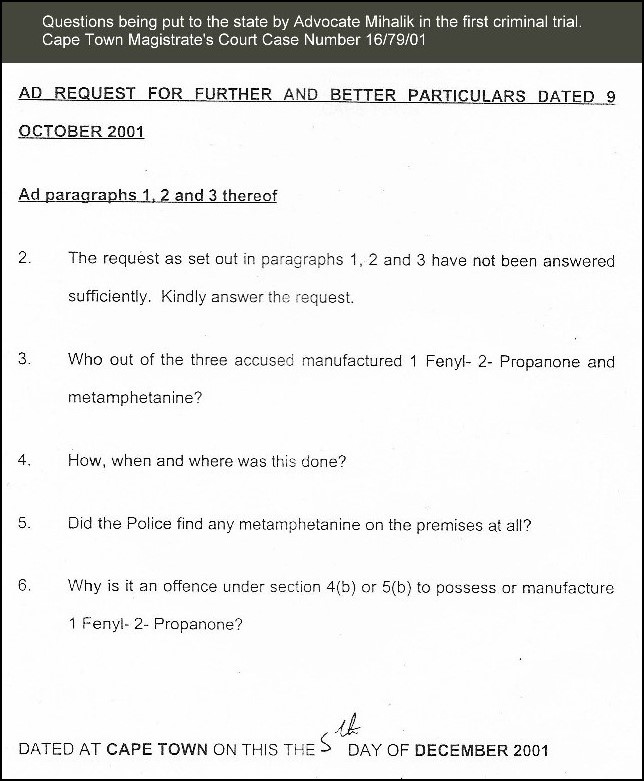
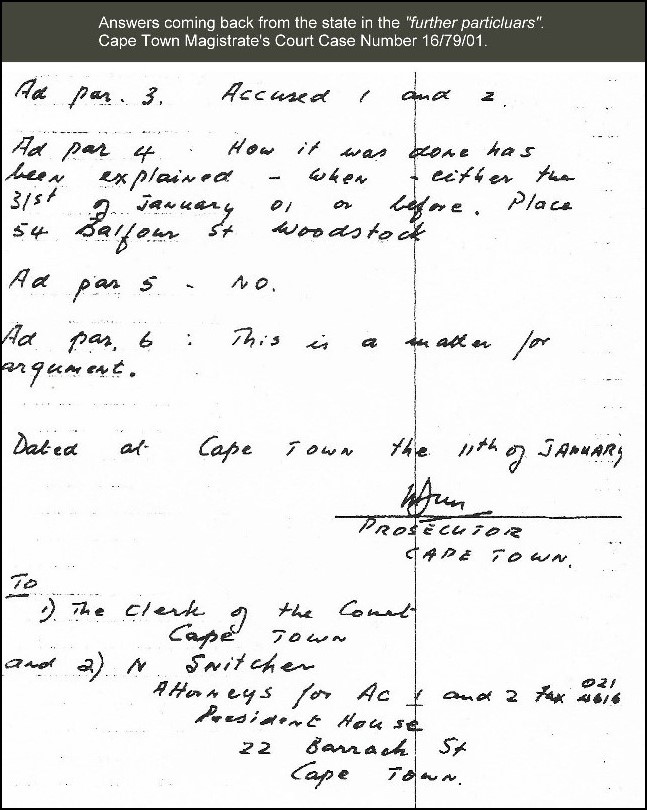
In
the first criminal trial, during the “further
particulars” in the Cape Town Magistrate's
Court Case Number 16/79/01 the question was
asked if the drug police found any
methamphetamine and the answer that came back
from the state was “NO”
On
the following pages, page number 18 and page
number19, are my copies of pages taken from the
further particulars with questions to the state
from Mihalik and the answers provided by the
state. These documents can also be found in
files that were submitted to the Constitutional
Court Case Number 56/05.
In
question number 5, Mihalik asks “Did the
police find any methamphetamine on the premises
at all?” On the following page, page number
19, is my copy of the reply from the state and
the state's reply to Mihalik's question is
“Ad par 5 – NO.”
So
we have an admission from the state that no
methamphetamine was found. The inclusion of
“at all” in this context means that not even
a forensic ghost of methamphetamine was found
during the unlawful search at 54 Balfour Street.
After my arrest the state has made false public
claims that 54 Balfour Street had been operating
as an illegal clandestine drug manufacturing
laboratory for at least 2 years. Also coming
from the state is another false claim that the
drug police, when they unlawfully entered into
my home, caught me red handed in the final
stages of manufacturing methamphetamine. If
there was any truth in either of these two false
claims then what are the chances that the
forensic drug police were unable to find any
methamphetamine when half a dozen trained drug
detectives including specialized forensic
detectives, after a two day search of my home,
did not find any methamphetamine or any traces
of methamphetamine when that is what they were
looking for?
Does
finding no methamphetamine point to my innocence
or does it point to my guilt? These are
incontrovertible facts. I was not acquitted on a
“technicality.”
It is poisonous
and an act of cruelty against my dignity to say
that I was acquitted on a
“technicality”
without
studying the facts and to present the statement
in such a way to imply there from that I am a
criminal.
|
QUESTION NUMBER TWELVE:
During the criminal trial Cape Town Magistrate's
Court Case Number 16/236/03 did the arresting
drug police officer, while being questioned
under oath, make a compelling confession that
points to my innocence.
CLUE:
It
can be shown from the criminal trial transcripts
that, after a lengthy examination of all the
chemicals that were seized unlawfully by the
drug police during the unlawful search of 54
Balfour Street and when questioned and asked by
Magistrate le Roux in the Cape Town Magistrate's
Court Case Number 16/236/03, if he, the
arresting officer, had found anything at 54
Balfour Street that would warrant an arrest in
terms of the Drugs and Drug Trafficking Act 140
of 1992, then the drug police man answered with
a “NO.”
On
the following page number 21, from my copies of
the transcripts of the second criminal trial, on
page 117, starting at line 21, Magistrate le
Roux asks the drug policeman “you find all
these substances...in his garage in his home,
his private dwelling, and he hasn't manufactured
any illegal drugs, can you charge him for
anything...under this Act, under Act 140 of
1992, there is nothing you can charge him for?”
and to this
question the drug policeman answers with
“No, no way.”
Let
this sink in.
I
have heard it being said that my acquittal in
the criminal trial was on a technicality but
whoever has arrived at such an inane conclusion
has not taken the trouble to study the facts of
the case.
Below on the following page number 21 is the
relevant extract copied from my copies of the
transcripts of the second criminal trial in the
Cape Town Magistrate's Court Case Number
16/236/03. The full copy of these transcripts
can be found on my website at:
https://www.simonprophet.com/trialnumberthree.htm.

|
QUESTION NUMBER
THIRTEEN:
In the second
criminal trial Cape Town Magistrate's Court Case
Number 16/236/03 was I acquitted of the alleged
criminal drug charges for which I had been
arrested in 2001?
CLUE:
On the following
page below is my copy of the court document from
the Cape Town Magistrate’s Court Case Number
16/236/03 with Magistrate le Roux's signature
that I was not guilty of the drug dealing
allegations.

|
QUESTION NUMBER FOURTEEN:
When
I was found to be not guilty in the criminal
trial can we then say that I must therefore be
perceived to be innocent?
CLUE:
To
put this in perspective, let's look at another
case scenario.
When
Judge Desai was found not guilty of having raped
a woman in India then can I say or publish in a
public place that Judge Desai did rape the woman
and that he was guilty of raping the woman?
Can
I say or publish that his acquittal was just an
opinion?
Can
I say or publish that he got off on a
technicality?
Can
the state go ahead and ignore the findings of
his criminal trial and punish Judge Desai?
|
QUESTION NUMBER FIFTEEN:
Do
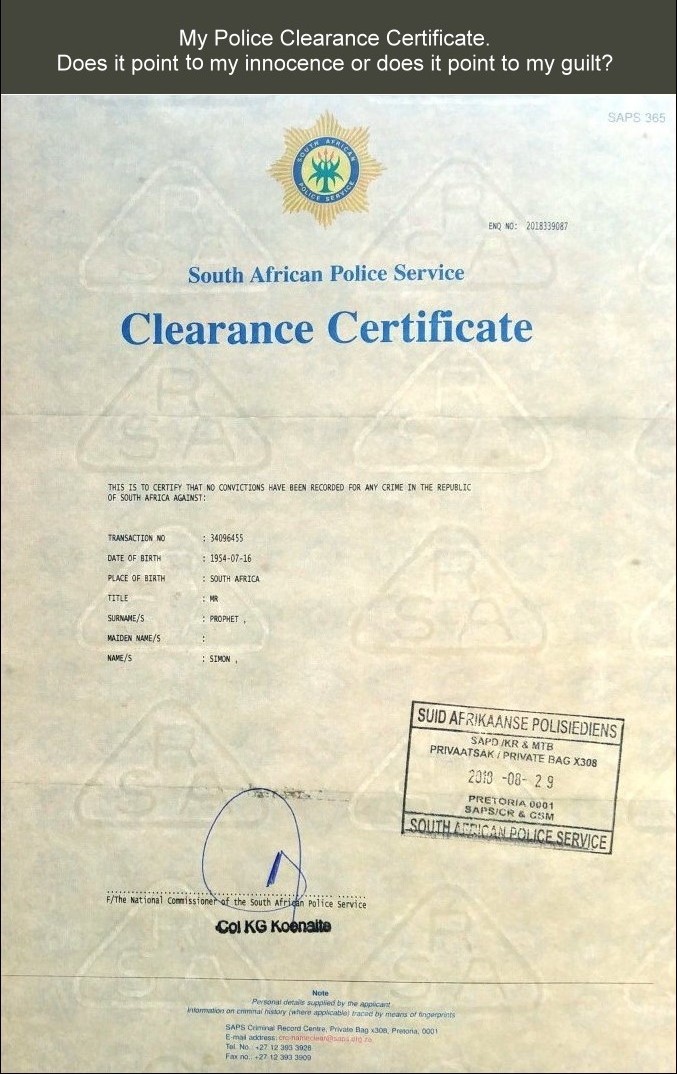
I, Simon Prophet, have a clean criminal record
according to my Police Clearance Certificate?
CLUE:
On
the following page below is a copy of my Police
Clearance Certificate.
I
have never been found to have been guilty of
contravening any section of the Drugs and Drug
Trafficking Act 140 of 1992 and if ever I had
been found guilty on drug charges then there
would be mention of that on the certificate but
my certificate states that no convictions for
any crime are recorded against me.
I
think that it would be fair to say that this
document points to my innocence.
Erasmus has told lies about me and I am not
going to be quiet and let him get away with
violating my right to dignity by calling me a
drug dealer without having given me a “fair”
chance to defend my innocence.
|
QUESTION NUMBER SIXTEEN:
During the proceedings of my criminal trials
between 2001 and 2005 while I was an accused
person and during the time while the
Constitution was safeguarding my right to
dignity and securing my right to presumption of
innocence, did Erasmus violate my non-derogable
right to presumption of innocence by declaring
in his judgement, on a platform outside of the
criminal trial and during the proceedings of
that criminal trial that I was guilty of the
same alleged crimes of which I was a
“suspect” in the criminal trials which
were yet to be concluded?
CLUE:
In
2003, in a civil case, on a platform outside of
my criminal trials, in his judgement against me,
Erasmus, regarding the same criminal charges
that I was facing in the criminal trial, made a
proclamation that I fell within the definition
of being a drug dealer.
See
the Erasmus Judgement in the High Court Cape
Town Case Number 5926/01 and to quote from
Paragraph 12 Judge Erasmus states “Accordingly
both the importation of phenyl acetic acid and
the manufacture of 1-phenyl-2-propanone puts
respondent
(Simon Prophet)
firmly within the definition of having dealt in
an undesirable dependence producing drug.”
In
my original appeal to the Judicial Service
Commission, in the “Sentence of Seven Lies”
I examine this sentence in detail and I have
shown beyond a reasonable doubt that the
malevolent claims made by Erasmus are lies and
nonsense but to have proclaimed, for whatever
reason, before my criminal trial had been
concluded, that I was guilty of the charges that
I was facing in those same criminal allegations
is forbidden by the Constitutional Law of
presumption of innocence.
Section 35(3)(h) is a Non-derogable Law.
|
QUESTION NUMBER SEVENTEEN:
Was
it unlawful and against the law, according to
the Constitution Act 108 of 1996, for Erasmus to
have engaged against me, an innocent man who, by
Constitutional Law and International Law must
have been presumed to have been innocent, by
declaring in a public place on a platform
outside of my criminal trial, during the
proceedings of my criminal trial, that was
dealing with the identical criminal allegations,
that I was guilty of the same criminal charges
that I was facing in the criminal trials?
CLUE:
Page
back to read again the clues given in QUESTION
NUMBER SEVEN and QUESTION NUMBER EIGHT with
regard to local and International laws.
The law of the right
to presumption of innocence during the
proceedings cannot be derogated not ever and
this law leaves no room for ambiguity and I am
not going to allow Erasmus or anyone else to
tell me that it isn't the law or that in certain
circumstances that it can be derogated.
According to me and
according to what I read in the Constitution,
Erasmus, engaged numerous law violations against
me and by not complying with Constitutional law,
Erasmus also gave permission and further
facilitated the unlawful things being done to me
by the National Director of Public Prosecutions.
|
QUESTION NUMBER EIGHTEEN:
Did
Erasmus punish me by depriving me of my property
without compensation while I was an accused
person and a “suspect” awaiting my
criminal trial that was dealing with the
identical criminal allegations upon which
Erasmus made his findings?
CLUE:
I
was arrested in 2001 and in 2003, Erasmus
forfeited my home, my property and my business
before my second criminal trial ended in 2005.
|
QUESTION NUMBER NINETEEN:
During the proceedings of my criminal trials
while I was a “suspect” but still
being presumed to be innocent, by dictate of
Constitutional Law and International Law, was it
an international crime for Erasmus to have
engaged against me by declaring in a public
place on a platform outside of my criminal
trial, during the proceedings of my criminal
trials, dealing with the identical criminal
allegations, that I, the “suspect”,
had to be
punished by having my properties
forfeited without compensation on account of the
same suspected crime that I, the “suspect”,
was suspected of having committed?
CLUE:
Article 1 of the
Convention against Torture and Other Cruel,
Inhuman or Degrading Treatment or Punishment.
Adopted and opened for signature, ratification
and accession by General
Assembly resolution
39/46 of 10 December 1984 entry into force 26
June 1987, in accordance with article 27 (1):
“1.
For the purposes of this Convention, the term
"torture"
means any act by which severe pain or
suffering, whether physical or mental, is
intentionally inflicted on a person for such
purposes as punishing him for an act he is
suspected of having committed...”
UNIVERSAL
DECLARATION OF HUMAN RIGHTS (1948, art. 5)
INTERNATIONAL
COVENANT ON CIVIL AND POLITICAL RIGHTS (1976,
art. 7)
"Introduction:
Torture seeks to annihilate the victim’s
personality and denies the inherent dignity of
the human being. The United Nations has
condemned torture from the outset as one of the
vilest acts perpetrated by human beings on their
fellow creatures.
Torture is a crime under international law.
According to all relevant instruments, it is
absolutely prohibited and cannot be justified
under any circumstances. This prohibition forms
part of customary international law, which means
that it is binding on every member of the
international community, regardless of whether a
State has ratified international treaties in
which torture is expressly prohibited. The
systematic or widespread practice of
torture constitutes a
crime against humanity."
|
QUESTION NUMBER TWENTY:
Did
Erasmus pre-empt and thwart my defence in the
criminal trial during the proceedings of that
criminal trial by violating my right to
presumption of innocence and proclaiming that I
was guilty of the same criminal allegations that
I was facing in the criminal trial?
CLUE:
In
2003 Judge Erasmus granted the state's
application to forfeit my home on the grounds
that I was guilty of having contravened the
Drugs and Drug Trafficking Act 140 of 1992 and
also declared that the property, 54 Balfour
Street, my home was an instrumentality of a
crime that enabled me to supposedly commit the
same alleged crimes of which I was being accused
of in the criminal trials.
|
QUESTION NUMBER TWENTY ONE:
Did
the Prosecution in the second criminal trial use
the Judgement of Erasmus to encourage and
endorse my conviction in that criminal trial?
CLUE:
From
Paragraph 10 of the Erasmus Judgement we read
from Erasmus that: “Should the accused
believe he has suffered an infringement of his
right against self-incrimination he can rely on
section 35(5) of the Constitution in the
criminal trial. It will be up to the trial court
to ensure compliance with fair criminal
standards, this may involve finding that any
derivative evidence is excluded because it was
found as a result of compelled testimony.”
Let
me correct Erasmus about the notion of a
“belief”.
It
is not a question of “belief” that I have
suffered infringements of my rights.
According to me, it is beyond the shadow of a
doubt that both Erasmus and the National
Director of Public Prosecutions have infringed
multiple civil right violations including
multiple Non-derogable civil right violations of
Constitutional Law and both Erasmus and the
National Director of Public Prosecutions have
also violated multiple International Laws and
both Erasmus and the National Director of Public
Prosecutions have engaged Criminal Acts against
me including the act of having tortured me.
Some will say that
to threaten someone with harm is intimidation
but when the threat is being delivered in order
to get information or to force a confession then
that is an act of torture.
Let's examine some of what has transpired since
Erasmus has tortured me by punishing me in a
time frame during the proceedings of the
criminal trial while I was a “suspect”.
From
my copies of the second criminal trial
transcripts on page 131 line 29, an extract of
which follows below, the Public Prosecutor
presents, not some isolated part of the
forfeiture trial, but he presents the entire
Judgement of Erasmus into the criminal court as
supposed to be evidence that I was guilty as
charged.

|
QUESTION NUMBER TWENTY TWO:
Did
Erasmus proclaim that 54 Balfour Street was an
instrumentality of a crime?
CLUE:
In
2003 in his judgement in the High Court of Cape
Town Case Number 5926/01, Erasmus, granted the
forfeiture of 54 Balfour Street because,
according to him, it was an “instrumentality
of a crime.”
|
QUESTION NUMBER TWENTY THREE:
Did
Erasmus proceed to dispose of the
instrumentality of the “suspected” crime
during the proceedings of the criminal trials?
CLUE:
On
the strength of the ruling of Erasmus then the
National Director of Public Prosecutions
proceeded almost immediately with the curator
bonis who negotiated and invited scores of
strangers to enter into and inspect my home, the
supposed to be instrumentality and a key object
of evidence for the defence in the criminal
trial, and all of this took place some two years
before the criminal trial ended and then, all
while I was living in my home, an agreement to
sell 54 Balfour Street was entered into and was
signed to an Australian citizen, Mr Hodge, in
2003.
|
QUESTION NUMBER TWENTY FOUR:
If
54 Balfour Street was an instrumentality of a
crime in the civil trial then would it be
logical to follow and conclude and say that the
same supposed to be instrumentality would also
be determined to be an instrumentality of a
crime in the criminal trial?
CLUE:
See
the Criminal Procedure Act 51 of 1977.
|
QUESTION NUMBER TWENTY FIVE:
If
54 Balfour was an instrumentality of a crime
then can it be said that as an instrumentality
that it could also be defined as evidence
especially so if the defence decided that there
was a need to present the supposed to be
instrumentality in the forthcoming criminal
trial as evidence?
CLUE:
See
the Criminal Procedure Act 51 of 1977.
|
QUESTION NUMBER TWENTY SIX:
Did
Erasmus rule to dispose of evidence, viz. 54
Balfour Street, that I could have used as
evidence to defend my innocence in my criminal
trial during the proceedings of the same
criminal trial that involved the same supposed
to be instrumentality?
CLUE:
On
page 126 from line 23 from my copies of the
transcripts of the second criminal trial, an
extract of which is on the following page 37,
the Public Prosecutor makes false claims about
me not opening the door to give the police
access to my home. The Prosecutor talks about 5
requests from the drug police to gain entry and
we have video footage of the drug police
smashing out doors but we see or hear no such
requests. From the way that 54 Balfour Street
had been built it can be shown that sound does
not travel from the front of the house to the
back of the house so someone standing at the
back of the house would not have heard any
banging at the front door of the house and the
only way that one could demonstrate this would
be to demonstrate this on site on the property.
Disposing of the property would be to eliminate
this demonstration of evidence.
The
various rooms, where each was situated, the
function of the rooms, the garage sale business
and what things were said to have been found
where, all of this information and evidence
would have been essential and fundamentally
important for the defence in building the
defence case and also demonstrating how the drug
police played out their role and what they did
while inside the property.
For
example I would have wanted to show where and
how the arresting officer attacked me, assaulted
me, climbed on top of me, pointed his gun into
my face, threatened to kill me and how his
colleague then handcuffed me onto the burglar
bars in the lounge. Nicola Daniels, the co
accused in the case, could also have given
testimony on site to explain what she witnessed.
Going through the motions on site provides a
much more accurate description and has a
tremendously more powerful impact on the jury or
to a Magistrate than just talking about it an
impartial and far away court room.
To
sell my house and attempt to dispose of it
during the proceedings of the criminal court was
destruction of evidence by Erasmus and the
National Director of Public Prosecutions.
Since the state and Erasmus were of the opinion
that the house was an instrumentality of the
suspected offence then it goes against all
reason to dispose of such important evidence
during the criminal trial unless we can conclude
that this supposed to be instrumentality was
only an instrumentality in the civil trial but
in the criminal trial somehow all of a sudden it
was not?

|
QUESTION NUMBER TWENTY SEVEN:
Is
it against the law and a crime to dispose of any
evidence that could be useful for the defence as
evidence during the proceedings of a criminal
trial?
CLUE:
See
the Criminal Procedure Act 51 of 1977 where
disposing of evidence constitutes a criminal
act. See also the Promotion of Access to
Information Act 2 of 2000.
|
QUESTION NUMBER TWENTY EIGHT:
After I was arrested then did I have the right
to silence during the proceedings of my criminal
trials?
CLUE:
Section 35(3)(h) of the Constitution. “Every
accused person has the right to remain silent
during the proceedings;”
|
QUESTION NUMBER TWENTY NINE:
Is
the right to silence a Non-derogable Right that
cannot be derogated?
CLUE:
In
the Table of Non-derogable Rights Section 35 can
be found in Section 1 and the “Extent to
which this right is protected” appears as
“with respect to subsection (3)” in column
3.
|
QUESTION NUMBER THIRTY:
Did
Erasmus, colluding with the National Director of
Public Prosecutions, find ways to disregard
Section 35(3)(h) of the Constitution and to
derogate my Non-derogable Right to silence
during the criminal proceedings?
CLUE:
From
the Erasmus judgement High Court Cape Town Case
Number 5926/01, in Paragraph 11, Erasmus had
this to say:
“In principle
then in every such case where civil and criminal
proceedings are instituted by the same activity
the respondent is called upon to make a tough
choice. He must weigh up the consequences and
resolve the ‘dilemma’ in which he finds himself.
The respondent in this matter
clearly made his choice by filing a
comprehensive answering affidavit. Accordingly
no good grounds have been made out for
suspending the civil proceedings.”
I
signed the affidavits because the National
Director of Public Prosecutions had tortured me
into signing those documents from the terrifying
threats that had been sent to me from S Omar
working for the National Director of Public
Prosecution in a letter to my lawyer dated 11th
of January 2002 stating that if I failed to
submit answering affidavits into the civil trial
on matters relating to the criminal charges
pending in the criminal trial that then in
consequence, by inferal, that I was going to
loose my home and my business.
Back
in 2001 and not understanding the nature of
Section 35(3)(h) was folly on my part but given
a second chance I would never have signed any
such affidavits during the proceedings of the
criminal trials and knowing then what I now
know, my reply to S Omar would have been to have
initiated criminal charges against both S Omar
and the National Director of Public Prosecutions
for torture.
Torture does not come with a statute of
limitations which is a consideration that now
sits squarely in the hands of the Judicial
Service Commission who must make a decision
regarding my complaints.
Every accused person has the Right to Silence
and this is a Non-derogable Absolute
Constitutional Supreme Law that is endorsed and
protected by International Law and I am not ever
going to allow anyone to ever try to tell me
that it isn't or that it can be derogated.
When
the policeman arrests you and then reads you
your Miranda rights then you are told that you
have the right to silence then that is what that
means. You have the right to silence.
Who
hasn't seen this in how many Hollywood movies?
This law has been drummed into everyone
everywhere so who are S Omar, the National
Director of Public Prosecutions and Erasmus to
think that they can circumvent this absolute law
by quoting some obscure court case that somehow
gives them the entitlement to ignore Supreme
Non-derogable Constitutional Law and
International Law?
Just
because I collapsed under torture and submitted
affidavits does not mean that Erasmus nor the
National Director of Public Prosecutions can now
assume indemnity from having tortured me and
forced me under duress to sign those affidavits.
No
they cannot.
I
withdraw everything and anything that has ever
been presented in any affidavits that I signed
and my lawyers submitted while I was under the
duress of having been tortured during my
criminal trials and I accuse S Omar, the
National Director of Public Prosecutions and
Erasmus of having tortured me during the
proceedings of my criminal trials.
Below on the following page 43 is a copy of the
letter signed and sent to my lawyer by S Omar
from the office of the State Attorney in Long
Street, Cape Town. I have included my markings
to show that S Omar cannot deny his knowledge
that my Non-derogable Right to Silence was being
trampled on and how I had been psychologically
and mentally tortured by the terrifying threats
contained in the letter to force me to talk
specifically on issues relating to the criminal
trials.
Being deprived of your home for which you have
paid good money and being deprived of your
business which you have built up over some 5
hard years is not a small threat.
Do
not think for one moment that this horrific
threat coming from S Omar and the National
Director of Public Prosecutions is a small thing
and is insignificant.
Loosing your home is one of the worst things
that can happen to a person.
Add
onto that also the loss of your business and
your income then this falls into the category of
an absolute disaster the likes of which is too
terrifying to contemplate.
People have committed suicide for having lost
less.
To
threaten me with the loss of these things, to
put me in a corner, to violate my right to
silence and to trick me and to instil fear into
me and to force me to answer on critical issues
relating to the criminal trial during the
proceedings of my criminal trial is torture.
Don't anybody try to tell me it isn't. I know. I
lived through it then and I'm still suffering
now.
Also
do not anybody try to tell me that this is
“frivolous and lacking in substance.”
Let
there be no doubt in anyone's mind that these
acts of torture that I am bringing to everyone's
attention are criminal acts and they are defined
by International Law as Crimes Against Humanity
and again, let me repeat myself, that, if I must
go the International Criminal Court in the Hague
to prove my point then that is what I will do.
According to me and from the evidence that I am
presenting in this appeal, Erasmus is guilty of
having punished me while I was a “suspect”
during the proceedings of my criminal trials and
as I understand the law to be, it is an
International Crime against humanity to punish a
“suspect”.
Judge Thring in his Judgement was correct to
have said that it goes against sound judicial
policy to forfeit someone's house before he has
been tried. It certainly does and the current
manifestations of his concerns are what we are
now witnessing here in living colour.
Erasmus put the cart before the horse and
forfeited my property in 2003 and in 2005 I was
found to be not guilty of the same alleged
crimes for which Judge Erasmus decided to punish
me.
For
whoever is reading this, please bear in mind
that I have also laid criminal charges of
perjury against the National Director of Public
Prosecution’s star witness, Casper Venter, for
having lied in 2 different affidavits that were
submitted to Erasmus and if Casper Venter is
found to be guilty then there is literally
nothing that the state has that can be held
against me.
A
guilty verdict against Venter will be not be
good for the National Director of Public
Prosecutions because it will follow that the
Constitutional Court will be called upon to set
aside the judgement against me and we know where
that will take us having looked at what happened
to Alex Jones.
The
drug police found nothing illegal in my home
during their unlawful search and Erasmus
condemned me on a made up speculative story
coming from the National Director of Public
Prosecutions and we are heading towards an
accounting but at this point in time, again, let
me repeat myself, that I am still willing to be
reasonable and to sit down with the National
Director of Public Prosecutions and work out a
settlement.
I
don't want to ruin anyone's life but at the very
least then I must be compensated for the
material losses that have been forced to bear
upon me by the National Director of Public
Prosecutions.
The
Judicial Service Commission has the influence
and the authority to reason with the National
Director of Public Prosecutions to short circuit
what can become events that lead to prominent
people being convicted of crimes against
humanity that will send them to jail.
A
reasonable reconciliation between me and the
National Director of Public Prosecutions can
avoid such unpleasant things from materializing.

|
QUESTION THIRTY ONE:
Did
Magistrate le Roux rule in the criminal trial
rule that the search and seizure by the drug
police at 54 Balfour Street was unlawful?
CLUE:
Please refer to Annex VRL1 in my original
appeal. Below is an extract from my copies of
the transcripts from the second criminal trial
on page 162 in line 4 which is the ruling of
Magistrate le Roux that the “search and the
seizure was done in an unconstitutional
fashion”.

|
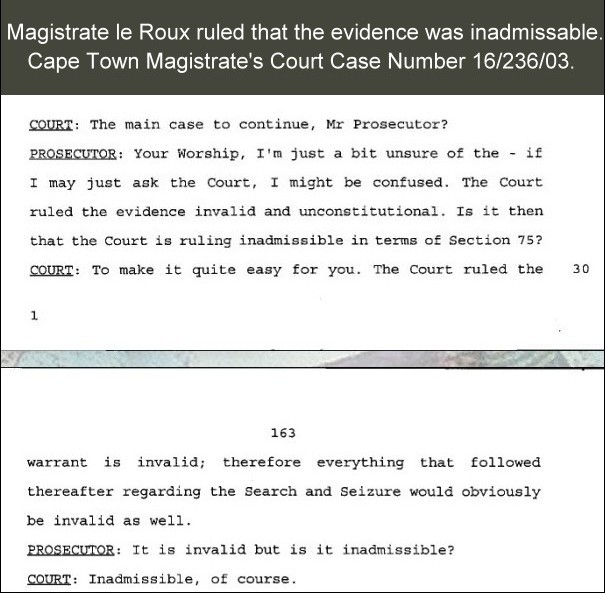
QUESTION NUMBER THIRTY TWO:
Did
Magistrate le Roux rule that the evidence is
inadmissible?
CLUE:
From
the criminal trial transcripts on page 162 line
26, the extract from my copies below on the
following page 46 we read the question put
forward by the Public Prosecutor and the answer
from the Magistrate; “Inadmissible of
course”.
|
QUESTION NUMBER THIRTY TWO:
Is
there a law in South Africa that forbids the
presentation of specific evidence in a court
room if that specific evidence was obtained
unlawfully?
CLUE:
Section 35(3)(5) of the Constitution.
“Evidence obtained in a manner that violates any
right in the Constitution must be excluded if
the admission of that evidence would render the
trial unfair or otherwise be detrimental to the
administration of justice.”
Again here we have another Supreme
Constitutional Law that by its nature is Non-derogable
but it gets worse because not only is this law
Non-derogable but the criminal trial ruled that
the presentation of the supposed to be evidence
in question was “inadmissible”
which means
that anyone who submitted this same supposed to
be evidence into a court room was doing so in
violation of Constitution Law but also in
contempt of a court finding.
|
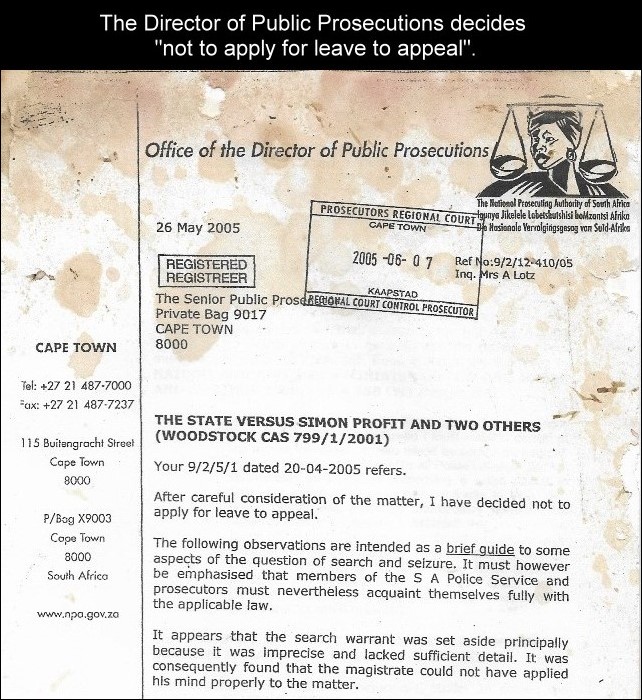
QUESTION NUMBER THIRTY THREE:
Did
the Director of Public Prosecutions decline to
appeal the findings of Magistrate le Roux that
the search and the seizure of things from 54
Balfour Street was unlawful?
CLUE:
Please refer to Annex VNDP to be found in my
original appeal which is a communication
from the Office of the Director of Public
Prosecutions that had accepted as final the
decision of Magistrate le Roux and
furthermore made an admission that the
Director of Public Prosecutions would not
appeal the judgement of Magistrate le Roux.
An extract from my copy of this
communication is on the following page 49.
|
QUESTION NUMBER THIRTY FOUR:
Is
there any case law that prohibits forfeiture if
the evidence obtained to invoke the forfeiture
was obtained unlawfully?
CLUE:
In 1958
Plymouth Sedan v. Pennsylvania 380 U.S. 693
(1965) was a Supreme Court of the United
States case handed down in 1965. The Court
ruled that civil forfeiture could not apply
where the evidence used to invoke the
forfeiture was obtained illegally.
|
QUESTION NUMBER THIRTY FIVE:
Have
criminal charges for perjury been opened against
Casper Venter relating to the affidavits that
the National Director of Public Prosecutions
submitted to Erasmus?
CLUE:
In March 2023 I opened criminal charges in
the Cape Town Central Police Station against
Casper Venter and the Criminal Case Number
is 1438/3/2023. The matter has been referred
to the Senior Prosecutor, Mr Jacobs, at the
Cape Town Magistrate's Court and I am
expecting to have the Criminal Court Case
Number sometime this month, January 2024.
Casper Venter submitted, according to me,
his two fraudulent affidavits into a civil
trial outside of my criminal trials during
the proceedings of my criminal trials and by
falsely proclaiming that I am a criminal in
those affidavits, Venter, was violating my
right to presumption of innocence as
scrutiny of the law books will confirm and
so the criminal trial against Venter kicks
off with confirmed unlawful activity on his
part. Add onto that the lies about me that
Venter has included in his thesis that was
submitted to the University of South Africa
2020 and it is not looking good for him.
However, whether I like it or not, at this
point in time, the law does afford Venter
his Constitutional right to presumption of
innocence but as the victim of Venter's
alleged crimes, unless the National Director
of Public Prosecutions can come to an
agreement with me regarding my grievances,
then, as a convincing witness who knows this
thing inside out, I will be doing absolutely
everything in my power to present myself and
others coupled with laboratory
demonstrations of fact to prove my point
beyond a reasonable doubt that Venter has
lied under oath and to make sure that Casper
Venter is convicted for the crimes of which
I have accused him.
The Judicial Service Commission have copies
of my complaints against Venter where I have
exposed his lies and even before any
conviction is legally confirmed, it is my
opinion, that anyone, who applies their
mind, can only agree that my allegations are
compelling so let there be no excuse here to
pretend ignorance of the facts as they are.
One can sympathize for Venter and hope that
he doesn't get into trouble but what are my
options if the National Director of Public
Prosecutions continues to insist on being
obtuse regarding my grievances?
|
QUESTION NUMBER THIRTY SIX:
Will
it be easier and cheaper for the National
Director of Public Prosecutions to pay me
between R5 600 000 and R11 200 000 in an out of
court settlement than to face the consequences
of me being successful in obtaining one or more
convictions that are being presented in my
“Criminal Allegations”?
CLUE:
If any one of my allegations end up with a
criminal conviction then it will be game
over for the National Director of Public
Prosecutions and dire consequences can be
the result of telling lies as we have
witnessed with the victims of Sandy Hook who
have successfully sued Alex Jones for more
than R20 000 000 000 (20 billion rand)
The civil right and criminal allegations
that I have at my disposal do not end with
what I have presented here above. There is a
lot more that can be added with a long list
of violations, both civil and criminal.
My one time arrest culminated into 2
different criminal trials where I was asked
to plead two different times, once in 2002
and again in 2004 to the same criminal
charge from the same arrest, where I put 2
different pleas of not guilty before two
different Magistrates, Magistrate Matthews
and then Magistrate le Roux, representing
two different court cases with two different
court case numbers, Case Number 16/79/01 and
the second criminal trial Court Case Number
16/236/03, and I was represented by two
different sets of lawyers, Norman Snitcher
and Piet Mihalik in the first criminal trial
and Sylvester Vogel and William Fischer in
the second criminal trial, and the two
different criminal trials spanned together
over a period of more that four years and
the courts never admitted fault and never
refunded my money from their blunder that
caused the first criminal trial to collapse
and I paid a lot of money twice for both of
the two different criminal trials to be
found not guilty in both of the criminal
trials and then I'm being told that I was
acquitted on a technicality so I deserved to
be punished in the most cruel way imaginable
by being deprived of my home, my property
and my business and being cast out into the
darkness and the dangers of the street with
just the clothes on my back after the
National Director of Public Prosecutions had
seized my cars and personal possessions when
I was evicted from my home after the
National Director of Public Prosecutions had
convinced the Woodstock police with another
made up story that I was going to shoot
anyone who tried to evict me which resulted
in the police arresting me for being in
possession of an illegal firearm when the
same gun for which I was arrested belonged
to me and was also registered to me with the
police and I am still the registered owner
of the same gun.
And then let's not forget that the civil
trial of Erasmus was a third trial and
although it has been hailed as a “civil”
trial it was, nevertheless, a trial that
was dealing with whether or not I was a
criminal so personally I don't see how such
a trial can be determined to be a civil
trial especially when the burden of proof is
of a lower standard of proof than proof
beyond a reasonable doubt which would
automatically render the civil trial
“less” fair than the criminal trial and
therefore obviously “unfair.”
So in my reckoning I have been tried 3 times
from one arrest.
Do we have a Non-derogable Supreme
Constitutional Law that is clear on this?
Section 35(3)(m): “Everyone has the right
to a fair trial which includes the right not
to be tried for an offence in respect of an
act or omission for which that person has
previously been either acquitted or
convicted.”
On the
subject of “dignity”,
did Erasmus put my character in a bad light
by declaring that I fall into the definition
of being a criminal drug dealer?
Is the right to dignity a Non-derogable Law?
Did Erasmus violate my right to dignity?
What entitles Erasmus to dangle my right to
dignity on a “balance of probabilities”
and a “reasonable suspicion”?
Is proof on a “balance of probabilities”
a lower standard of proof than proof beyond
a “reasonable doubt”? For the
accused, is a trial that is determined on a
“balance of probabilities” and a
“reasonable suspicion” less fair than a
trial that is determined as “proof beyond
a reasonable doubt”? If a trial is
determined to be “less fair” for the
accused then can we say that such a trial is
still fair for the accused? When does a
trial that is “less fair” become a
trial that is “not fair”?
When Erasmus forfeited my home did he ignore
the findings of Magistrate Matthews that the
search warrant to enter into my home had
been declared invalid?
When Erasmus forfeited my home was he
unaware about the findings of Magistrate le
Roux that the drug police were unlawfully on
my property.
When Erasmus forfeited my home was he
unaware about the findings of Magistrate le
Roux that the seizure of my property was
unlawful?
When Erasmus forfeited my home was he
unaware that in the second criminal trial
the arresting officer admitted that nothing
was found in my home that would warrant an
arrest in terms of the Drugs and Drug
Trafficking Act 140 of 1992?
When Erasmus forfeited my home was he
unaware that there was no evidence against
me because the “supposed to be”
evidence, which as it turned out under
scrutiny, didn't amount to anything
unlawful, had been declared
“inadmissible”?
We can go on and on and on.
|

In
its concern regarding human rights, last week,
South Africa presented to the International
Court of Justice its complaints that Israel has
committed crimes against humanity and for having
taken a stand on human rights, South Africa has
received both praise and condemnation.
Did the Jews steal
land from the Palestinians? To be honest, I
don't know but land has always been a
contentious issue all the way back into Biblical
times but to stay current, here at home, on the
question about land, then let me say that what I
do know is that the National Director of Public
Prosecutions has carelessly wasted vast public
resources to deprive me of my land.
It is my opinion
that an important function of government is to
protect people's land and so, most definitely, I
do not think that it should be a function of the
state to dedicate its time to deprive people of
land especially when South Africans are living
in constant fear of being robbed and hurt and
even murdered. Over the past year more people
have been murdered in South Africa than the
current total death rate from the war in Gaza.
It's ironic that Malema condemns Israel for
genocide while he cheers and chants “shoot to
kill”.
We should be
agreeing that the right to life is a given and,
also that the right to freedom is also a given
but what about the right to own land?
When Section 25, the
right to land, is destroyed then we have nowhere
to go but chaos and despair.
From false
allegations against me, the National Director of
Public Prosecutions has achieved to destroy my
civil right to my own land that I bought and
paid for and without just cause, both Erasmus
and the National Director of Public Prosecutions
have tortured me, and have treated me and
punished me in a cruel, inhuman and degrading
way and have deprived me of my dignity, my
property, my home, my business, my cars and my
personal possessions.
What
is it going to take for the National Director of
Public Prosecutions to see this for what it is?
I am giving the National Director of Public
Prosecutions a more than fair chance to do the
right thing.
Failure of the National Director of Public
Prosecutions to sit down with me in a meaningful
way will result in these papers being included
in a complaint to the International Criminal
Court or to an appropriate body that can provide
the relief that I am seeking.
Perhaps the Judicial Service Commission can
intervene, for the benefit of all, to prevent
this from becoming an embarrassing or should I
say disgraceful International public spectacle?
|
|
